Translate

Wednesday, February 25, 2015

February 12, 2015
Our Winter Farm Trip

Students have been learning about Measuring and exploring different ways to measure. We went on our Winter farm trip in January and students wanted to measure the animals that they observed on the farm. The Farmer discussed with students how the hand was used to measure the height of a horse. Students became interested in creating a mural of life size animals they saw on the farm. The farmer helped the students by measuring the animals with their hands so we would have a baseline for each animals height. When using the hand as a unit students learned it is about 4 inches.
 Students came back to school and began working on observational drawings from the farm. They drew the animal they liked and then students selected a students drawing that would become part of our wall mural. They used their original drawing and traced it on acetate and used the projector to determine the live size of each animal. The students are finishing the mural and we have decided to add some of our own students to compare animal height to students. They really enjoyed the measurement project. Students are able to identify the difference between length and height.
They understand that there are many different units that can be used to measure.
Students B: We can use our hands, cubes, blocks, paper clips!
Student M: Big John is huge! He was taller than you!

Students B: The rooster is shorter than the baby goat. He needs feathers on is tail!
 
The projected has been incorporated into Math Module 4. Students used plastic animals with paper clips, cubes, tiles to practice measuring both length and height.
 
K.MD 1. Describe measurable attributes of objects such as length.
K.MD 2. Directly compare two objects with a measurable attribute in common, which object is more/ less and describe the difference,
More to come when the mural is complete!

Thursday, January 22, 2015

What is this?

Thursday, January 22, 2015

What is this and what can we use it for?

Teacher: What do you think this is?
Student M: It's a measuring box!
Student J: It looks like a truck.
Student C: We could put quarters in it!
 Teacher: Why would we put quarters in it?
Student T: When you go to the store it tells you how much it is?

Teacher: What happens if I put the cubes on one side and the rooster on the other side?
Student M: It got heavier and it tilted. It can measure what it weighs.
Student MP: Yeah, its tells you how heavy or light it is.


Teacher: What can we do with the cubes?
Student B: Put them in and count them.
Teacher: When do I stop putting the cubes in?
Student B: When both sides are the same!

Students continued to count while we put the cubes in  and they counted 15 cubes were the same as the rooster.
Teacher: What can we say about the rooster and the cubes in a sentence.
Student M: The rooster weighs 15 cubes!
Teacher: Boys and girls lets repeat the sentence together!
Everyone: The rooster weighs 15 cubes.

Welcome to the snowman factory!

Thursday, January 22, 2015

Students have been reading, discussing and learning about winter. We created a snowman factory with snow dough for students to explore and build their own snowman. The students have been discussing winter and the weather outside. We are discovering the seasons change and so does the weather. Students are identifying the changes in weather happen when the seasons change.
Teacher:What happens when it snows outside?
Student T said: It gets cold outside! BBBrrrr...
Student J said: You have to wear a hat, coat, gloves.
Student E said: You need the thing around your neck, a scarf!


Student A: I made a snowman! He is melting.
Teacher: Why did you make him melting?
Student A: He kept falling down, so I made my snowman in the shovel, now he won't fall down!


Thursday, January 15, 2015

Where do animals go in the Winter?
 
Wednesday, January 14, 2015
 
Students are reading about and discussing Winter. We have read the stories The Mitten, The Hat, Every Season, and Warm Clothes. They created a web about Winter, discussed hibernating, student M said hibernating is when animals sleep in the winter. They talked about the words cold, freezing, snow, ice, mittens, gloves, boots, hats, snow pants, and a coat.
 
Student then identify the clothing in pictures that was needed to keep them warm when they are outside. We were able to put them in the order they should get dressed to go outside. We talked about animals wearing clothes like in the story and student J said Animals do not wear clothes people do!
 They were able to recall the story The Hat by Jan Brett. Student J said They go places to stay warm.
 
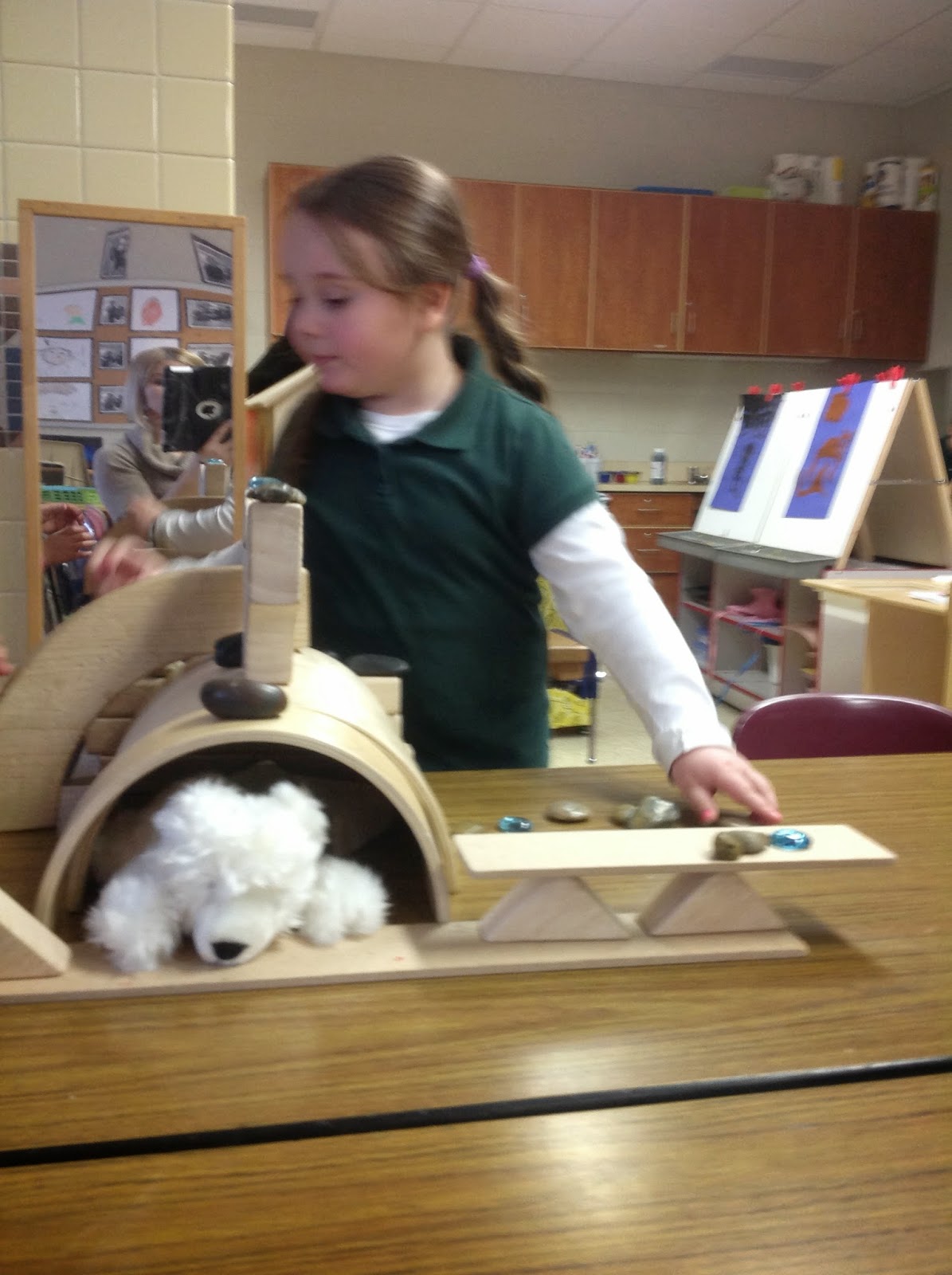
This is when are discussion began about where animals go in the winter and how they are able to keep warm. Students then read the story Sleep, Bear Sleep. We identified the different animals in the winter and where they went. Students discovered that some animals sleep in a cave, den and a burrow. They were excited to talk about a bear sleeping.
 
Student A said I made him a cave to stay warm and the rocks around the cave are fish in case he gets hungry!
 
Student R said We made a home for the bear and a dog. I made a ramp from them to climb in so they can get in and out.


Students M and Z said Our bear is hibernating because it is cold and winter. The front has a shower and the rocks are the water. His name is Freddie he likes to eat fish and berries, oh and honey! The rocks on the bottom by the cave are fish for Freddie to eat.


Student A said: My bear is sleeping in his cave!


Wednesday, January 7, 2015

January 6, 2015
 

What can I create with shapes?

Students read the story mouse shapes and were trying to use different shapes like the mice did in the story. Students then told me about what they created and how they used the shapes like the mice. Students were able to tell me about the story and create their own connection to literature by using the shapes to build. We created a connection for math and discussed the shapes in the story and students identified the shapes they were using to create their own image.


Students S: My fish lived in the bottle. He jumped in there! He was stuck and I could not get him out. My mom put him in the bowl with the turtle and he stinks really bad. They need a bath really bad. Then they need to have dinner.
Student A: I made a shark in the pool.
Teacher: Why did you make a pool for the shark?
Student A: The shark called my house and he asked me to make them one!

Student Z: I made the cat and my friends helped me make the three mice from the story.
Students J: We could make the animals out of shapes! Just like the story!
Student B: I made a scary mouse because it can scare the cat, Now he is a scaredy cat! I don't think he will come back.

Thursday, December 4, 2014

December 4, 2014
"This is my house, I know it" ~ Marcos
 
Students are continuing to work on and complete their house projects. They have created many drafts and are now on their final steps of the project. It has been eye opening for the students and for myself to observe them paying more attention to detail and really trying to improve their house every step of the way.
One student said we do not have the color gray and my house is gray. He was getting upset until we showed him you can mix black and white to make gray. He was so relieved he thought he would have to use another color and that was not what he observed on his photograph. Students are not just drawing and coloring with any colors they are trying to create a realistic picture that is not just a painting or drawing, but their home.
They have created beautiful pieces of artwork that represent not only themselves, but their families and who they are and where they are from.
They are proud of their work, their families and their home. They are defining who they are and growing as child, developing as a student and becoming a confident individual who is part of a community.


 Aiden~5 years old

Angela ~ 5 years old
 Xiomara~ 5 years old


Zoeliz ~ 5 years old
 
Common Core:
 
Geometry: K.G Identify and describe shapes (squares, circles, triangles, rectangles, hexagons, cubes, cones, cylinders, and spheres).
 
1. Describe objects in the environment using names of shapes, and describe the relative positions of these objects using terms such as above, below, beside, in front of, behind, and next to.
 
ELA-Literacy:
CCSS.ELA-Literacy.L.K.1.D Understand the question words (e.g. who, what, where, when, why how).
 
CCSS.ELA.-Literacy. L.K.1.F Produce sentences in shared language activities.
 
CCSS.ELA-Literacy.W.K.8 With guidance and support from adults, recall information from experiences or gather information from provided sources to answer question.
 
Language
5c. Identify real-life connections between words and their use (e.g. not places at school that are colorful).
November 25, 2014
What can you paint for Thanksgiving?
 
Students were given white paper, paint brush, watercolors and the question what can you paint for Thanksgiving? I asked the students to create a painting for the Holiday so they could share something with their families that was made by them and created by them. The students were given the supplies and the question. They all decided to paint a turkey for the holiday and they came out beautiful!
 
Shaun told Audrianna Your turkey looks awesome! She said, Thanks its for my Mom!
 
Ralina, My turkey is running so he does not get eaten!
 
 
What are you thankful for this Thanksgiving?
Radfan, I love my family!
The students are taking the time to look at each other's work and they are complimenting one another and helping each other. I observed another student take their friends paint brush and help them make the Turkeys feet. They gave the brush back and they both continued their own paintings. Helping one another can go a long way. They are making lasting impressions on each other and understanding that they are part of a growing community/ family in kindergarten.

Happy Thanksgiving!